How Market Volatility Impacts Crypto Strategies in 2026
How Market Volatility Impacts Crypto Strategies in 2026
Crypto market volatility remains one of the biggest factors influencing investor decisions. In this article, we explore how volatility affects different strategies and how users are adapting with more structured approaches like staking on platforms such as ZexStone.
How Market Volatility Impacts Crypto Strategies in 2026
Volatility has always been a defining feature of the cryptocurrency market. Prices can rise or fall rapidly, creating both opportunities and challenges for investors.
In 2026, volatility still plays a major role, but the way investors respond to it has changed. Instead of reacting emotionally to price movements, many are adopting more structured and balanced strategies.
What Is Crypto Market Volatility?
Volatility refers to the rapid changes in asset prices over a short period of time.
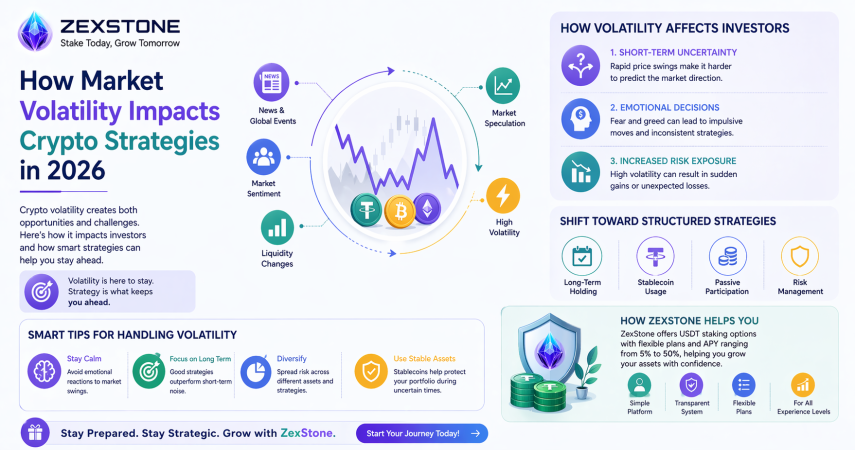
In crypto, volatility is often higher than in traditional markets due to:
- Market speculation
- News and global events
- Liquidity changes
- Investor sentiment
While volatility can create opportunities, it also introduces risk.
How Volatility Affects Investors
1️⃣ Short-Term Uncertainty
Frequent price changes can make it difficult to predict market direction.
2️⃣ Emotional Decision-Making
Investors may react quickly to market movements, leading to inconsistent strategies.
3️⃣ Increased Risk Exposure
High volatility can result in sudden gains or losses, depending on market conditions.
Shift Toward Structured Strategies
In response to volatility, many investors are moving toward more stable and manageable approaches.
These include:
- Long-term holding
- Stablecoin usage
- Passive participation methods
These strategies focus less on short-term price changes and more on consistent involvement.
Role of Stablecoins in Volatile Markets
Stablecoins like USDT provide a way to navigate volatility more effectively.
They help by:
- Reducing exposure to price swings
- Providing a stable value reference
- Supporting structured strategies
Because of this, stablecoins are becoming a key part of modern crypto participation.
How ZexStone Helps Users Navigate Volatility
ZexStone is designed to support users in a volatile market environment.
By offering USDT staking options, the platform allows users to participate in crypto without relying solely on price movements.
With APY ranging from 5% to 50%, ZexStone provides structured options for users to engage with the ecosystem.
Key features include:
- Simple platform interface
- Transparent reward system
- Flexible participation options
- Designed for all experience levels
Smart Tips for Handling Volatility
- Avoid making decisions based on short-term price movements
- Focus on long-term strategies
- Diversify your approach
- Use stable assets to balance risk
Final Thoughts
Volatility is a natural part of the crypto market, but it doesn’t have to be a barrier.
In 2026, investors are becoming more strategic, focusing on stability, simplicity, and long-term participation.
Platforms like ZexStone help users adapt to these conditions by providing accessible tools and structured options.
Share This :
Latest Blog
How to Start Crypto Staking with USDT: A Step-by-Step Guide
21 April, 2026
Bitcoin vs Stablecoins: What Investors Prefer in 2026
31 March, 2026